
Multi-agency data sharing to tackle drugs harm
Effective and timely data sharing is one of the biggest challenges faced by policing today and an area that Principle One has no lack of experience in working to address. Often our work is focused on sharing data within or between forces or from a local to national level to enable a timely response to crime and provide the information required to drive responsive, informed decision making.
However, in tackling not just the effects of crime but its causes, policing has to work effectively within a multi-agency context – obtaining and sharing data with other national and local government agencies as well as with the third sector. This may involve sharing data between forces and the courts system to enable effective safeguarding, working with the providers of out of court interventions to reduce court backlogs for minor offences or, in this case study, working with local authority teams to respond to drug related incidents.
Drug Related Deaths have now reached the highest levels since records began in 1993, with 5,565 drug-related deaths, the equivalent of 93.9 deaths per million people in 2024.[1] In parallel, there has been a concerning rise in deaths due to synthetic opiods such as nitazene, with at least 179 confirmed deaths between June 2023 and May 2024[2], fueling concern over an increasingly toxic drug supply. Dame Carol Black’s independent review, completed in 2021, stressed the need for a coordinated approach to drug policy “To move forward, departments must work together to invest in and improve treatment, employment, housing support and the way that people with addictions are treated in the criminal justice system.”[3]
Local Drugs Information System (LDIS) teams have been established to drive this collaboration, bringing together stakeholders across policing, health, local authorities and third sector organisations with a focus on responding to the threat posed by novel, dangerous or contaminated substances. Effective information sharing is key, but with these organisations each working on their own IT systems and often receiving data through a range of manual mechanisms, getting access to timely alerts can be extremely challenging.
Principle One has been working with Thames Valley Police and Berkshire East and West’s LDIS Coordinator to develop a pilot system to address this problem. This provides a centrally hosted Drugs Alerting Dashboard that can be accessed by all stakeholders across the region with a bespoke data pipeline to automate the range of manual data feeds, often received via email, clean and format data, making it available more rapidly. Development work was undertaken on the Microsoft technology stack, making use of a range of tools that are already available to policing and seeking to avoid long term lock-in to an off the shelf product.

The Dashboard has been developed with a modular design pattern that can easily be amended or enhanced to support different ways of working across other local authorities and forces. Its functionality has been broken down into four core areas, each of which can be customised to support local ways of working and to offer flexibility to adapt to future requirements.
The Drugs Alerting Dashboard has been in use across the LDIS and with Thames Valley Police since April, and is already delivering a range of benefits across the end user community:
Reduced Manual Effort: improving productivity and enable more time to be spent on analysis and development of interventions;
Improved Data Quality and Consistency: implementation of common data standards, data cleaning and formatting to improve data quality across all sources and enabling consistency in reporting and monitoring long term trends within the data;
Rapid alerting and sharing data across partners: enabling visibility of new and existing cases, enable notes to be added and alerts sent to partners, streamlining data management, reducing manual efforts and maintenance of data locally and enabling faster, more informed decision-making; and
Rapid access to snapshot and trend data: tailored dashboards provide partners with insights by substance, location, and more, offering them a clear, visual overview of drug related death, identifying both local hotspots and longer-term trends, enabling data-driven collaboration, planning, and interventions.
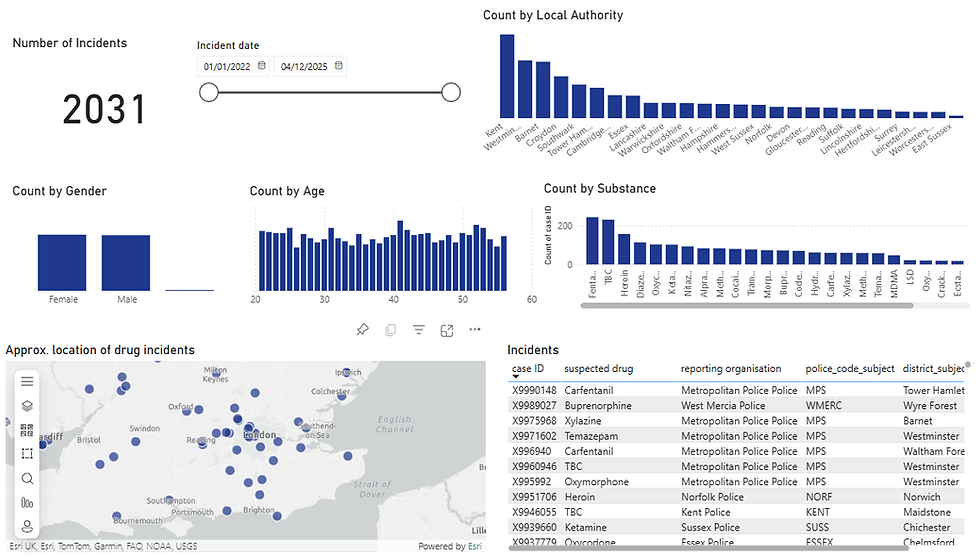
Populated with synthetic data
For Jason Kew, Berkshire East and West Combatting Drugs Partnerships Lead and LDIS Coordinator, the Dashboard has helped accelerate the pace at which he and the wider Partnership can respond to incidents. “The role of the LDIS is to identify emerging risks through the synthesis of all available information (Ambulance, Police, Coroners) and translate this onto a near live time visual dashboard, where all partners can see emerging hotspots for both fatal and near fatal drug overdoses - and crucially respond to these incidents to reduce harm. So far, the dashboard has shown drug trends, and the prevalence of cocaine and alcohol incidents and this information has altered our response to different communities. The dashboard is literally a lifesaver.”
The strong partnership with Thames Valley Police has shown how technology solutions can be embedded quickly while recognising that internal IT resources are often limited to support this type of multi-agency collaboration. It’s enabled more effective ways of working and has shown how access to the same data can enable different interventions – from proactive safeguarding of vulnerable individuals and disruption drug supply throughout the Thames Valley area.
For more information about the Drugs Alerting Dashboard, please contact policingapps@principleone.co.uk.
1 Office for National Statistics, Deaths Related to Drug Poisoning in England and Wales: 2024 Registrations, October 2025, Deaths related to drug poisoning in England and Wales - Office for National Statistics
2 Office for Health Improvement and Disparities, Deaths Linked to Potent Synthetic Opioids, GOV.UK, 3 October 2024, https://www.gov.uk/government/publications/deaths-linked-to-potent-synthetic-opioids.
3 Home Office, Review of Drugs, Part Two: Prevention, Treatment, and Recovery (London: UK Government, 2021), https://www.gov.uk/government/publications/review-of-drugs-phase-two-report/review-of-drugs-part-two-prevention-treatment-and-recovery
Comments