
Turning the Tide on Fraud: how the UK is modernising its response
Updated: Apr 13
Fraud has been around throughout human history from records going back to the Roman Empire describing tax fraud and document forgery, through to the infamous sale of landmarks including the Eiffel Tower and Brooklyn Bridge in the early 1900s.
Fraud has undergone a profound evolution in the 21st century, becoming one of the most sophisticated and lucrative forms of organised crime. Traditional scams centring around romance, investment and impersonation persist but modern communication systems and near flawless AI-generated content in any language provides fraudsters the ability to scale up faster and reach effortlessly across borders. To give an idea of the scale and frequency of these attacks ‘Three’ the UK mobile network operator, reported blocking over 20 million fraudulent messages between January and August 2024, the equivalent to over a hundred thousand a day.[1]
Fraud now represents 45% of all crime in the Crime Survey of England and Wales and the economic cost of fraud in England and Wales, reached over £14 billion in 2023–2024. The ‘Fraud Strategy 2026–2029’ encompasses the Government’s response, recognising fraud is not only a criminal threat but also a significant economic and national security issue. [2]

While the strategy is detailed and expansive, offering a directory of counter fraud activities, responsible organisations and innovative solutions to specific threats, it is light on the structure of how these organisations will collaborate and where the borders of responsibility will sit. A joined-up approach to fraud is supported by the recent White Paper on Policing Reform announcing the creation of a National Police Service (NPS) that will handle all national policing responsibilities, while also leading on fraud, counter-terror and serious organised crime. Placing fraud alongside these other threats gives a clear indication of its prioritisation, although potentially limiting the opportunity to lead change until the NPS is operational.
The Fraud Strategy adopts a three pillar framework; Disrupt, Safeguard, and Respond, supported by strengthened governance, cross sector collaboration, and significant investment. Collectively, these measures aim to reduce opportunities for fraud, enhance public resilience, and improve outcomes for victims.

The first pillar, Disrupt, is essential to tackling fraud. It focuses on a proactive approach, acting early to deny criminals access to the systems they use to conduct fraud. Most frauds in the UK feature a digital component to either communicate with victims or to compromise systems. Regardless of whether this is a ‘phishing’ email, fake courier SMS or directing people to a compromised website, fraudsters are exploiting the UK’s legitimate digital infrastructure. Criminals also frequently engage with and abuse legitimate financial systems to access and transfer victim’s assets into criminal control. This abuse of both communication and financial infrastructure creates additional costs for, and reduces trust in, the everyday essential services that these companies provide.
The Online Crime Centre (OCC), due to launch in April 2026, is planned to bring together law enforcement, the UK intelligence community and private sector partners from the financial, telecommunications, technology, and cyber industries. This will be a key part of delivery of the Disrupt pillar, designed to integrate public and private sector intelligence to improve threat analysis and coordinated interventions. The centre will be responsible for identifying the accounts, websites and phone numbers that organised crime groups rely on. Co-operating with industry to shut them down at scale, blocking texts, freezing criminal accounts, removing scam social media accounts and disrupting frauds before they even reach the public.
Previously, data held by international digital service providers, such as social media companies, was critical for fraud investigations but was a challenge to acquire as the businesses and their hosting infrastructure are frequently housed outside UK jurisdiction, with the only avenue available was through Mutual Legal Assistance (MLA) requests that could take months or even years to fulfil. The implementation of capability under the Crime Overseas Production Orders Act (COPO Act) allows law enforcement to obtain electronic data directly from service providers based outside the UK. Integrating this data with other intelligence and investigative sources opens up new opportunities to accelerate investigations and underlines the importance of data analysis skills at the centre of Law Enforcement’s ability to disrupt fraud.
The Safeguard pillar centres on reducing public and organisational vulnerability by improving education, resilience, and targeted preventative action. The expansion of the ‘Stop! Think Fraud’ campaign and integration of fraud education within schools demonstrates an intent to embed preventative knowledge across society. The strategy also describes the ‘PROTECT network’, made up of local, regional, and national law enforcement officers, aiming to identify at-risk individuals to intervene before harm occurs. There is a particular focus on young people and vulnerable adults, including measures to address exploitative money laundering and financial abuse, supported by dedicated referral pathways and strengthened coordination between law enforcement and partners such as The Children’s Society.
The third pillar, Respond, aims to improve victim experience and strengthen the operational capacity of law enforcement. Central to this is the introduction of the new Report Fraud service, intended to streamline reporting, triage vulnerability, and enhance intelligence sharing across policing. Report Fraud Victim Services is a single point of contact for all victims in the UK that provides a central repository, working with forces to manage risk at the local level and designed to dramatically improve the service received by victims.
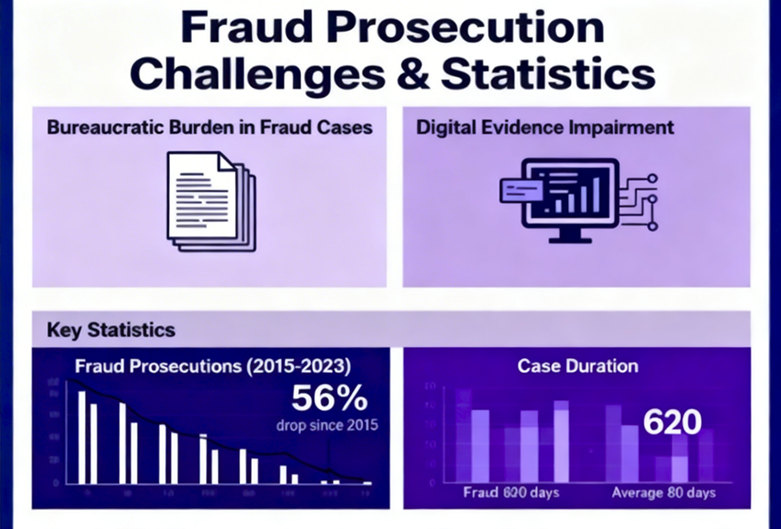
While maintaining victim focus is critical for responding to the needs of those that have been targeted and capturing data on the threat, there are some fundamental enforcement challenges around investigating fraud. For law enforcement to successfully prosecute fraud in a way that creates a credible deterrent to criminals it is essential to efficiently manage the bureaucratic burden around fraud cases. The proliferation of digital material, the complex nature of fraud cases and the volumes of data generated means that disclosure is an increasingly time and resource intensive process, which is acutely visible in the prosecution rates for fraud.
The proportion of fraud prosecutions resulting in convictions has remained broadly stable at 80% over the past 5 years, although the number of fraud cases being prosecuted overall has fallen 56% since 2015. [2] This is partially due to the rising volumes of digital evidence, with fraud cases now taking over 620 days to reach charge compared to 80 days for the average case.
While AI tools offer the opportunity for significant benefit, the effort required to get policing’s core data assets in order to begin development and testing of AI tools shouldn’t be underestimated. Policing has to balance the benefits of improved efficiency that AI offers against the need for police staff, stakeholders across the Criminal Justice System and the public to trust the use of AI its use. This represents a key dilemma within the public sector where AI training is critical to success, yet the data needed for training is often both operationally sensitive and subject to compliance with data protection and privacy constraints making it difficult (or completely inappropriate) to use it in this context.
This is where Principle One’s capability to generate comprehensive and coherent synthetic data at scale can help accelerate the development of new capabilities. By taking a scenario-based approach across a range of crime types, we can enable the rapid generation of consistent linked datasets mirroring the real world and offering significantly more value than the provision of isolated individual synthetic datasets. As the data is credible but not subject to the restrictions of using real world data it supports flexible testing and training at pace through providing large volumes of data to commercial suppliers to promote innovation and facilitate evaluation.

Overall, the Fraud Strategy presents a broad and ambitious programme that acknowledges the evolving nature of the threat. However, in many ways, the Strategy functions more as a map, a detailed illustration of the landscape, rather than a plan for action; it does not yet lay out a model for how each organisation should interact or the technology and data foundations required to enable their interoperability.
Despite being part of an uncertain wider policing landscape, where almost every aspect of the wider system of systems is subject to uncertainty, the strategy provides a clear pathway to prevent and mitigate against the fraud threat facing the UK. There is also a clear commitment, primarily through the now live ‘Report Fraud’ to improve the service fraud victims receive and better collect data to drive investigations. Most importantly the foundations are now in place for a cross-sector and multi-layered approach not only to prevent fraudsters exploiting the technology at the heart of our communications and finance infrastructure but rather to use them effectively in pursuit.
Comments